
What PersonaKit 0.1 does, how to run it locally, and what it will and will not do with your conversations.
Your AI's memory. Your say.
PersonaKit reads the conversations you already have with your coding assistants, proposes short memories about you, keeps the exact quote behind each one, and serves only what you allow back to your assistants over MCP. It runs on your machine. There is no PersonaKit server and no account.
Pre-release
PersonaKit is open source (Apache-2.0) and being built in public. These pages describe what exists in release 0.1. Anything not listed as Available is Planned.
The loop
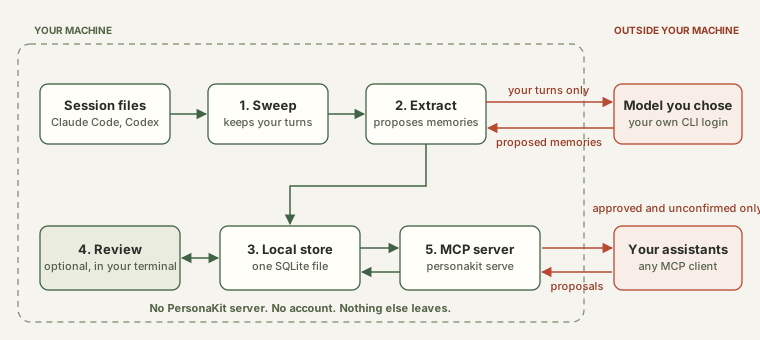
- Sweep. PersonaKit reads local Claude Code and Codex session files and keeps only the turns you wrote.
- Extract. A model you already use, through your own signed-in
claudeorcodexCLI, proposes short memories. Each one cites the turns it rests on. - Store. Memories and quotes go into a local SQLite file.
- Review (optional). Approve, restrict, hide, or forget. Unreviewed memories are served labelled unconfirmed.
- Serve. Your assistants read memories over MCP with the evidence attached.
Availability
| Capability | Status |
|---|---|
| Claude Code and Codex session ingest | Available in 0.1 |
| Terminal review, list, stats, forget | Available in 0.1 |
MCP server (personakit_read, personakit_propose) | Available in 0.1 |
| Duplicate merging, weekly digest, decay | Planned (0.2) |
| ChatGPT, claude.ai, Gemini exports | Planned (0.3) |
| Third-party name guard | Planned (0.4) |
| Hosted service or remote connector | Not available |
Where to go next
- Start with PersonaKit: install and run your first sweep.
- Core concepts: memories, evidence, and states.
- Memory controls: the review actions.
- Connections: sources and assistants.
- Trust and data boundaries: exactly what leaves your machine.
- Guide for AI assistants and
personakit_readreference. - Source, roadmap, and contributing: the PersonaKit repository on GitHub.